
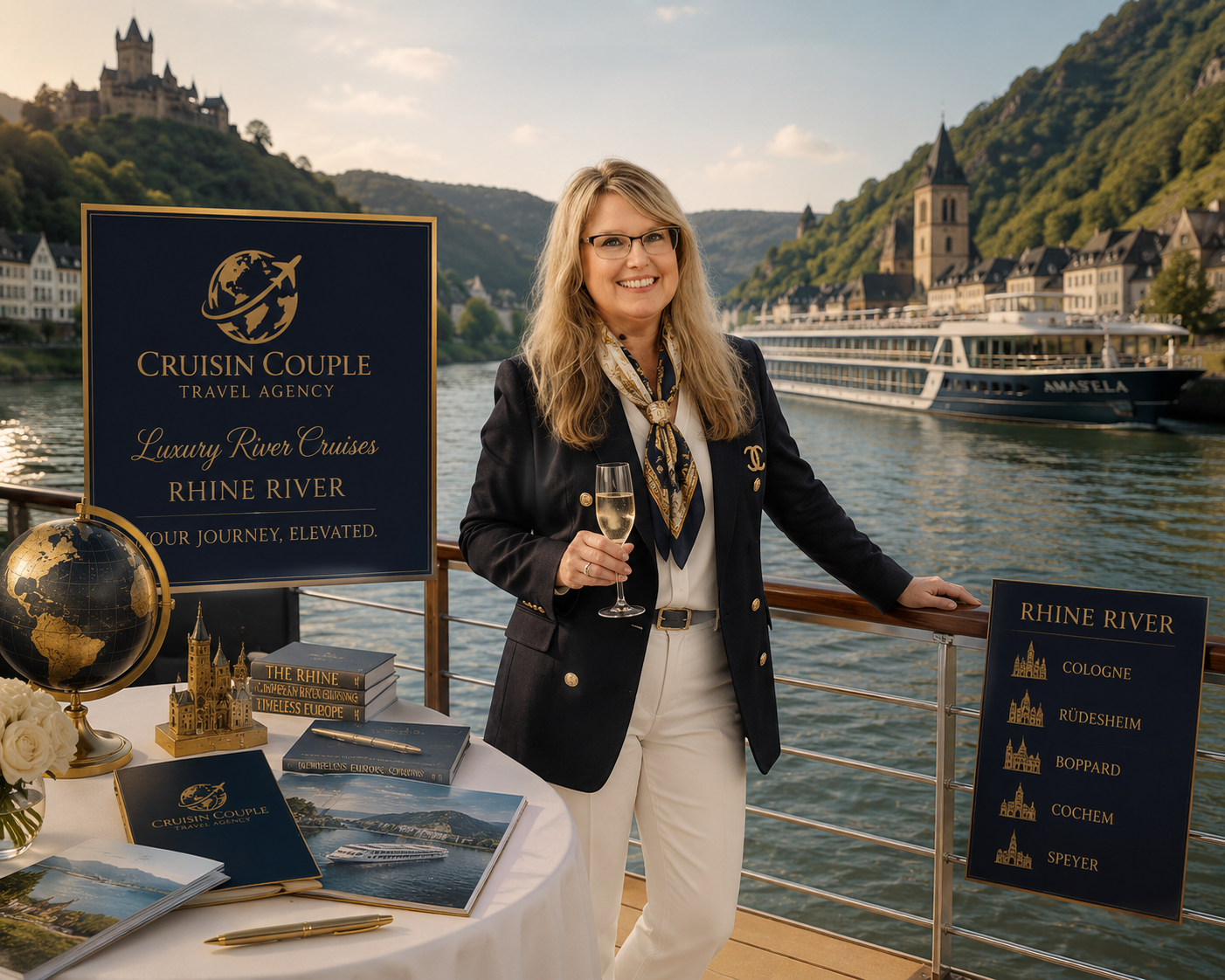
By Melissa Yetter, CLIA Certified Cruise Counselor (CCC), ACC, CTIE, ASTA Verified Travel Advisor
The answer depends entirely on what kind of traveler you are. River cruising offers intimacy, stillness, and the slow discovery of small towns and villages. Ocean cruising delivers scale, energy, and access to major cities and ports around the world. After six-plus years placing clients on both, I have learned that the right choice is almost never about the ship. It is about who you are when you travel.
River Cruise vs Ocean Cruise: At a Glance
| Experience | River Cruise | Ocean Cruise |
|---|---|---|
| Ship size | 120 to 180 guests | 700 to 5,000+ guests |
| Pace | Slow, unhurried | Active, activity-driven |
| Destinations | Small towns and villages | Major cities and ports |
| Motion | Smooth, no swells | Open water, some movement |
| Evening entertainment | Intimate, low-key | Broadway-style shows, multiple venues |
| View from the ship | Land on both sides, always | Open ocean on sea days |
| Best for | Wanderers, slow travelers | Explorers, activity seekers |
The Biggest Misconception About River Cruising
The single biggest mistake travelers make when comparing river and ocean is assuming that a smaller ship simply means a scaled-down version of the same experience. It does not.
Ocean cruising, even at the luxury tier, is built around stimulation. You are walking from the aft to the forward, choosing among twenty events happening simultaneously, attending Broadway-caliber productions, and navigating buffets and dining venues that feel larger than some hotels. The ship itself is a destination.
I have been on ocean sailings where the music is playing from the moment you step on deck to the moment the last venue closes. There is always something happening, always somewhere to be, always a choice to make. For many travelers, that energy is exactly what they came for. For others, it is exhausting by day three.
River cruising is the opposite. The ship is a floating boutique hotel, not a city. You will sail with 120 to 180 fellow guests at most. The evenings are quiet. Conversations happen. You hear people laughing at the table next to you rather than competing with a DJ. The pace is slow. Travelers who board expecting ocean-style activity programming are often surprised by how still everything is, and for the right traveler, that stillness is the entire point.
The noise level alone tells the story. Ocean ships, even the luxury ones, have a constant ambient energy. River ships have conversations. Both can be lively in the evening. But the quality of the sound is entirely different, and it reflects two completely different travel philosophies.
What River Cruising Actually Feels Like: A Moment in Mondsee
There is a moment from one of our sailings that I come back to often when I am describing river cruising to a client who has never done it.
We were on a sailing that took us through Vienna, and on the way to Salzburg we stopped in Mondsee, a small Austrian town most people have never heard of. We sat at a cafe on the side of a cobblestone road, a latte and dessert in front of us, watching the townspeople go about their afternoon. Locals were gathered at nearby tables, talking and laughing in German. I speak German, and just hearing the ease of the conversation, the warmth of it, the way a small town sounds when it is just being itself, was something I will not forget.
Right there across from us was the church where the wedding scene in The Sound of Music was filmed. We did not plan that. We were not standing in a tour group with a numbered paddle being herded from stop to stop. We were just sitting, watching, belonging to the moment.
That is river cruising. You do not always know what is around the next corner. You wander, and the town reveals itself to you. That kind of travel cannot be scheduled. It can only be made possible by slowing down enough to let it happen.
What Does a Luxury River Cruise vs Luxury Ocean Cruise Actually Cost?
Cost comparisons between river and ocean are difficult to make cleanly because both vary significantly by cabin category, cruise line, itinerary, and travel dates. What I can tell you is that at the luxury tier, the two are often closer in price than travelers expect, and the decision should never be made on price alone.
For a luxury river cruise, a well-appointed standard cabin on a premium line such as AmaWaterways might begin around $8,000 to $10,000 for two people. A suite on a line such as Riverside Luxury Cruises, which operates an all-suite, full-butler product at the very top of the river market, can reach $16,000 or well beyond for the same number of nights. Riverside is not an entry-level product. It is one of the most elevated river experiences available, and pricing reflects that positioning.
For a luxury ocean cruise, a standard verandah cabin on a line such as Regent Seven Seas or Silversea can fall in a comparable range. A large suite on the same sailing can reach $30,000 or more. The ocean range is wide because the product category is wide, from ultra-luxury expedition ships carrying 200 guests to premium vessels carrying 1,200.
The most useful framing is this: at comparable cabin categories, luxury river and luxury ocean are often closer in investment than travelers assume. What you are choosing between is not budget versus premium. It is two entirely different travel philosophies at a similar investment level. The right question is not which costs more. The right question is which experience is worth more to you.
What River Cruising Gives You That Ocean Cannot
River cruising gives you intimacy at every level, and that intimacy compounds across the sailing in ways that are difficult to describe until you have experienced it.
You dock in the heart of a town, not at an industrial port two miles from the city center. You step off the ship and you are already there. The cobblestone streets, the market square, the local bakery, all of it begins at the end of the gangway. There is no shuttle bus, no ferry tender, no waiting. You simply walk off and the place begins.
You will never see only open water. On a river, there is always land on both sides, always a village coming into view, always something to watch from your balcony. The scenery is in constant motion even when the ship feels perfectly still.
The fellow guests become real to you in a way that rarely happens on a larger ship. With 120 to 180 people aboard, you will recognize faces by day two. You will share a table with someone at dinner and still be following their travels on social media a year later. The scale of a river ship makes connection almost inevitable.
There are no swells. No sea sickness. The river is smooth and steady, which makes it an ideal choice for travelers who have hesitated about ocean cruising for that reason. I have had clients who had written off cruising entirely after a rough ocean crossing discover on their first time river sailing that the motion they feared simply does not exist.
Most importantly, river cruises give you the slower pace of discovery. You are not checking destinations off a list. You are wandering streets, turning corners without a plan, sitting in a cafe watching the town move around you. It is a sense of stillness even when you are seeing something new every day.
"You are not going to intentionally say, I want to go see this. You are going to wander streets based on wonderment, wondering what is around the next corner. Sit in a cafe and watch the town go by. That is river cruising." — Melissa Yetter
What Ocean Cruising Gives You That River Cannot
Ocean cruising gives you scale, variety, and access to major destinations in a way that river cruising simply cannot match. You will dock in cities: Barcelona, Dubai, Sydney, Juneau, Santorini. The ports are larger, the landmarks are iconic, and the energy of arrival in a major world city from the water is genuinely thrilling.
The ship itself is part of the experience in a way that river ships are not designed to be. Even on a luxury ocean line such as Viking Ocean, Seabourn, or Silversea, the vessel is expansive. The evening entertainment is polished and theatrical. The dining venues offer meaningful variety across multiple nights. The pools, the spa, the observation decks, all of it is part of the vacation, not just a means of getting from one port to another.
For a full day at sea, you have open ocean as far as you can see. That sense of scale, of being truly out on the water with nothing but horizon in every direction, is something a river cruise cannot replicate. For travelers who feel drawn to the ocean itself, not just the destinations it connects, that feeling matters.
Ocean cruising also gives you access to itineraries that river simply cannot reach. Alaska, the Greek islands, the fjords of Norway, the coast of Japan, the Antarctic. If the destination is on your list and it requires open water to reach it, ocean is the answer.
The activities and programming on ocean ships, particularly at the luxury tier, are also genuinely impressive. Enrichment lectures, culinary demonstrations, wine tastings, fitness programming, spa treatments, and evening performances give you a full slate of choices at every hour of the day. For travelers who want to feel busy and stimulated, that variety is a feature, not a flaw.
A Real Client Who Made the Switch
One of my clients came to me wanting an ocean cruise. They had heard about river cruising but assumed it was not for them. What they described as they talked through what they were looking for was a desire for a slower pace, a smaller environment, and the feeling of actually being inside the places they visited rather than passing through them.
I listened, asked a few more questions, and suggested we consider river instead. They were open to it.
They sailed in 2025. They loved it. Just last month they returned from their second river sailing.
That is the outcome I see most often when the match is right. It is not that ocean cruising failed them. It is that river cruising was simply a better fit for who they are as travelers. Once they experienced it, they did not want to go back to the larger ship environment, at least not exclusively. They now alternate between the two.
This is why I never tell a client what they should do. I tell them the differences, ask the right questions, and let the answer reveal itself. The best vacation is not the most popular one. It is the one that fits the traveler.
Who Should Choose River, and Who Should Choose Ocean?
When a new traveler calls me and asks which one they should do, I do not answer right away. I ask questions. I want to know how they vacation on land. I want to know what they remember most from their favorite trips. I want to know whether they come home from a vacation feeling energized or relieved.
The answers almost always point clearly in one direction.
Choose river cruising if you: - Prefer a slower, quieter pace over constant activity - Are drawn to smaller towns, villages, and off-the-beaten-path experiences - Want to feel genuinely inside the places you visit, not just passing through them - Are sensitive to motion or have avoided ocean cruising for that reason - Value intimacy and a smaller, more personal guest experience - Find overstimulation draining rather than energizing - Want your evenings to feel like conversation, not a production
Choose ocean cruising if you: - Want to visit major cities and iconic world destinations - Enjoy a full schedule of activities, entertainment, and dining variety - Love the experience of being out on open water - Prefer a larger social environment with more fellow guests - Want the ship itself to be a significant part of the experience - Are energized by options, activity, and a full daily schedule - Have destinations on your list that only ocean itineraries can reach
Can You Do Both? What Clients Who Alternate Between River and Ocean Say
Yes, and some of my most seasoned travelers do exactly that. They have not chosen one over the other. They have made room for both in their travel lives, and they plan accordingly.
What I observe consistently: clients who alternate tend to prefer ocean at the luxury tier, gravitating toward lines with fewer guests, typically in the 1,000 to 1,200 passenger range, rather than the mega-ship experience. They want the scale of ocean but not the overstimulation of a 5,000-guest sailing. They have calibrated toward the quieter end of the ocean spectrum.
They layer in river cruises as a counterpoint: a different rhythm, a different part of the world, a different way of being on vacation. A luxury Rhine sailing one year, a luxury Caribbean ocean itinerary the next. The two experiences complement each other well precisely because they are so different.
The traveler who has done both and loved both has usually learned something important about themselves: that they are not one kind of traveler. They are two. And they plan their years accordingly.
How to Decide If You Have Never Done Either
Start by thinking about how you vacation on land, not at sea.
If your favorite trips involve wandering a small town without an agenda, finding a cafe and staying longer than you planned, getting lost in a neighborhood and not minding at all, then river cruising is likely a natural fit. The experience on the water will feel familiar and right.
If your favorite trips involve checking off major landmarks, moving at a fast pace through big cities, filling every hour with an activity or excursion, and coming home having seen as much as possible, then ocean cruising will serve you better. The energy will match who you are when you travel.
Neither answer is wrong. Both experiences are genuinely extraordinary. The goal is to match the experience to the traveler, not the traveler to the experience.
A certified cruise advisor can walk you through both options, ask the right questions, and help you arrive at an answer that fits. That conversation costs nothing and can make the difference between a vacation that is good and one that changes how you see the world.
The Bottom Line
River cruising is not ocean cruising on a smaller ship. It is a fundamentally different way to travel: quieter, more intimate, more connected to the places you visit, and built around stillness rather than stimulation.
Ocean cruising is not the louder, less refined alternative. At the luxury tier, it is an extraordinary experience in its own right: expansive, polished, and capable of taking you to corners of the world that no river can reach.
The right choice comes down to knowing yourself. Ask the right questions and let the differences do the work. A certified cruise advisor can walk you through both options in detail and help you identify which experience aligns with who you are as a traveler.
About the Author
Melissa Yetter is a CLIA Certified Cruise Counselor (CCC), Accredited Cruise Counselor (ACC), Certified Travel Industry Executive (CTIE), and ASTA Verified Travel Advisor based in Chandler, Arizona. She is the owner of Cruisin Couple Travel Agency and holds specialist certifications across more than a dozen cruise lines spanning luxury ocean and European river cruising. She serves on the Board of Directors for the Arizona ASTA Chapter. Reach her at melissa@ccta.co, 602-558-0154, or at cruisincouple.com.
Keep Planning
Compare both styles in depth on our river cruising specialty page and our luxury ocean cruising specialty page, then talk it through with Melissa Yetter.