Quick Answer
A Rhine Christmas market river cruise between Amsterdam and Basel can reach up to a dozen distinct markets, but no single sailing visits them all. The core stops on most seven-night itineraries are Cologne, Rüdesheim or Koblenz, the Heidelberg or Speyer area, Strasbourg and Breisach (for Colmar or the Black Forest), with Amsterdam and Basel as the bookends. This guide walks the river in order, so you can match the markets you care about to the itinerary that actually docks there.
I am Melissa Yetter, an independent luxury river cruise advisor. I have sailed the Rhine, inspected more than 25 river cruise ships and sailed a Christmas Markets itinerary myself. This is the destination companion to my Christmas Market river cruise planning guide. For a shorter ranking of the standouts, read Best Rhine Christmas markets to visit by river cruise.
How to Use This Guide
Each stop lists five things: where the market is, how far it is from where river ships usually dock, what the market is known for, how long you realistically need, and who the stop suits. Docks and hours vary by line and by week; treat distances as typical rather than guaranteed and ask me to confirm for your sailing.
Amsterdam (Netherlands)
The market: Amsterdam does not have a large traditional Christmas market. What it has is the Amsterdam Light Festival, art installations along the canals from late November into January, plus small seasonal markets on squares such as Museumplein, which also hosts an ice rink.
From the dock: Ships dock at the Passenger Terminal near Central Station or at outlying berths with a coach transfer. Central Station is a 10-minute walk from the old center.
Known for: Canal-side lights, museums, stroopwafels and the general glow of a city that is beautiful in winter.
Time needed: Treat it as a city day. Two pre-cruise nights is ideal.
Suits: Travelers who want culture and canals before or after the market-heavy days.
Cologne (Germany)
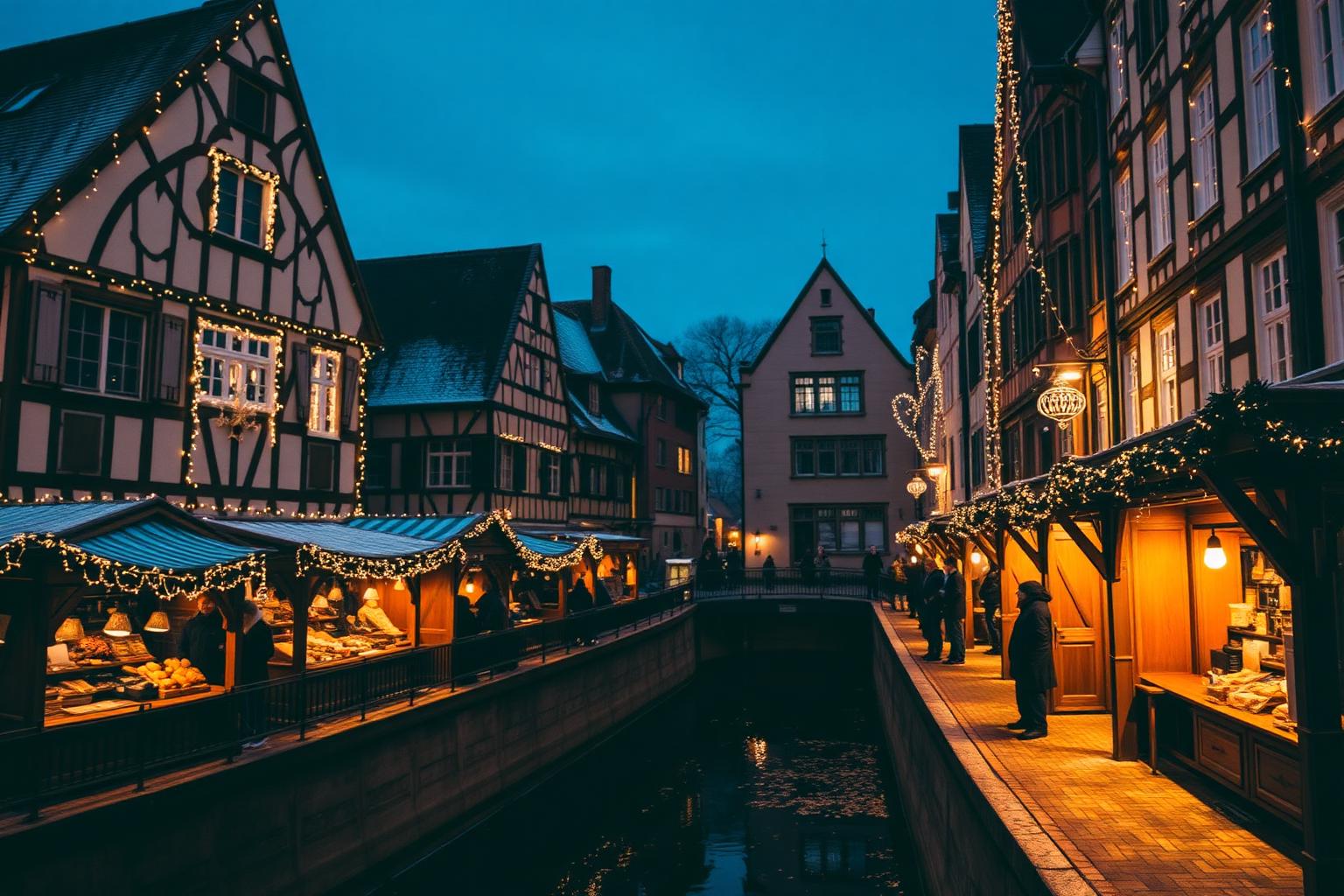
The market: Several. The Cathedral Market (Weihnachtsmarkt am Kölner Dom) sits under the twin spires with a giant tree and red-roofed stalls. Within 10 to 15 minutes on foot are the Old Town market around Alter Markt and Heumarkt, the Angel's Market on Neumarkt and the Harbour Market beside the Chocolate Museum.
From the dock: Most river ships dock along the Rheinauhafen or near the Hohenzollern Bridge, a 5 to 15 minute flat walk from the cathedral.
Known for: The most photographed backdrop on the Rhine, Kölsch beer served in small glasses, Reibekuchen (potato fritters) with apple sauce, and Christmas ornaments by the hundred.
Time needed: Half a day minimum, and stay for dark if the ship allows. This is the stop where evening hours matter most.
Suits: Everyone. Flat, close and iconic. It is also the easiest stop for limited mobility.
Koblenz (Germany)
The market: Spread across Am Plan, Jesuitenplatz, Münzplatz and the squares of the old town, a few blocks back from the Deutsches Eck where the Moselle meets the Rhine.
From the dock: Ships tie up along the Rhine promenade; the market is a 10 to 15 minute walk.
Known for: A relaxed, local feel, the cable car up to Ehrenbreitstein Fortress (seasonal hours vary), and a shorter list of stalls than Cologne.
Time needed: Two to three hours.
Suits: Travelers who want a low-key stop between the bigger names. Not every itinerary calls here; some sail straight into the Gorge.
The Rhine Gorge (Germany)
Not a market, but the day most travelers remember. Between Koblenz and Rüdesheim the river narrows past some 20 castles and the Lorelei rock. In December the hills are bare and often frosted, which makes the castles easier to see than in summer. Ships schedule this stretch in daylight; the best place to be is the lounge or, briefly, the top deck with glühwein.
Rüdesheim (Germany)
The market: The "Christmas Market of Nations" fills the Drosselgasse and the adjoining lanes and squares with around 120 stalls, many representing different countries.
From the dock: Two to five minutes. Rüdesheim is one of the most convenient market stops on the river.
Known for: Rüdesheimer coffee (Asbach brandy flambéed with sugar, topped with cream), Riesling glühwein, Siegfried's Mechanical Music Museum, and an outsized nativity display.
Time needed: Two to three hours; longer if you ride the cable car over the vineyards to the Niederwald Monument.
Suits: Travelers who want a small, walkable, storybook market. Cobbles throughout.
Mainz (Germany)
The market: Around the cathedral on Markt and Liebfrauenplatz, with a large nativity and a two-storey Christmas pyramid.
From the dock: A 10 to 15 minute walk from the Rhine promenade berths.
Known for: The Gutenberg Museum, Chagall windows at St. Stephan, and a solid, traditional German market without Cologne's crowds.
Time needed: Half a day.
Suits: Itineraries that use Mainz as the gateway to Heidelberg or as an alternative to Rüdesheim.
Speyer (Germany)
The market: Along the broad Maximilianstrasse leading to the Romanesque cathedral, with a small ice rink.
From the dock: A 10 to 15 minute walk.
Known for: The UNESCO-listed cathedral, the Technik Museum (with a Boeing 747 and a Soviet space shuttle), and a gentle, uncrowded market.
Time needed: Two to three hours, or use it as a base for the Heidelberg excursion.
Suits: Travelers who like a calmer day and an architectural highlight.
Heidelberg (Germany, by coach)
The market: Six linked market areas along the Hauptstrasse from Bismarckplatz to Karlsplatz, with an ice rink beneath the castle ruins.
From the dock: Heidelberg is on the Neckar, not the Rhine. Ships dock in Mannheim, Ludwigshafen or Speyer and coach you in, typically 30 to 45 minutes each way.
Known for: The castle lit above the market, Germany's oldest university, and a long, lively old town.
Time needed: A half-day excursion, often with a castle visit.
Suits: Travelers who want a dramatic castle backdrop and are comfortable with a long walk on cobbles. Tell me about mobility needs; the Hauptstrasse is nearly a mile long.
Strasbourg (France)
The market: The Christkindelsmärik, running since 1570, is really a network of markets: the cathedral square, Place Broglie, Place Kléber with its giant tree, Place Gutenberg, the Petite France quarter and a "guest country" market that changes each year.
From the dock: Ships dock in Strasbourg's port or across the river in Kehl, Germany. Either way expect a 15 to 30 minute coach or tram ride to the old town, which is an island.
Known for: Alsatian food that is genuinely different from the German stops: bredele cookies, tarte flambée, vin chaud blanc, foie gras and choucroute. Decorations here are the most elaborate on the river.
Time needed: A full day. If your ship offers a morning tour and a free afternoon, take that combination.
Suits: Travelers who want variety and atmosphere. The old town is flat but crowded and cobbled; weekends are very busy.
Colmar (France, by coach from Breisach)
The market: Five or six small markets across the old town and the Little Venice quarter, including one designed for children.
From the dock: Ships dock in Breisach, Germany; Colmar is a 30 to 40 minute coach ride.
Known for: Half-timbered houses in candy colors, the Unterlinden Museum, and a market that many travelers find prettier, if smaller, than Strasbourg's.
Time needed: A half-day excursion.
Suits: Travelers who want the picture-postcard Alsace village. If the itinerary offers Colmar and Strasbourg on separate days, that is a strong itinerary.
Breisach and the Black Forest (Germany)
The market: Breisach's own market is small. The reason to stop is the excursion: the Black Forest, often with a cuckoo-clock workshop, a Black Forest cake demonstration and, on some lines, a village market in Freiburg or Gengenbach.
From the dock: Breisach is walkable; Black Forest excursions run 45 to 75 minutes by coach.
Known for: Freiburg's market around the Rathausplatz and Gengenbach's town hall Advent calendar, one of the largest in the world.
Time needed: Half a day to a full day, depending on the excursion.
Suits: Travelers choosing between Alsace and the Black Forest; most itineraries make you pick one on this day.
Basel (Switzerland)
The market: Two connected markets on Barfüsserplatz and Münsterplatz, with more than 150 chalets, plus a smaller one in the Münsterplatz's "fairy-tale forest" for children.
From the dock: Most river ships dock in the St. Johann area, a 20 to 30 minute walk or short tram ride from the old town.
Known for: High-quality Swiss crafts, raclette, Basler Läckerli (spiced honey biscuits), and a beautifully lit cathedral square. Prices are in Swiss francs and higher than in Germany.
Time needed: Half a day, which is usually all a first or last day allows. Add a night if Basel matters to you.
Suits: Travelers who appreciate craftsmanship and a polished, less crowded market, and anyone extending into Switzerland.
Which Stops Will Your Itinerary Include?
| Stop | Typical on 7-night Amsterdam–Basel | Market walk from dock | Mobility |
|---|---|---|---|
| Amsterdam | Yes (start or end) | 10–20 min or coach | Easy |
| Cologne | Yes | 5–15 min, flat | Easy |
| Koblenz | Sometimes | 10–15 min | Easy |
| Rüdesheim | Usually | 2–5 min | Cobbled |
| Mainz | Sometimes | 10–15 min | Easy |
| Speyer | Sometimes | 10–15 min | Easy |
| Heidelberg | Often, by coach | 30–45 min coach | Long walk |
| Strasbourg | Yes | 15–30 min coach or tram | Flat, crowded |
| Colmar | Often, by coach from Breisach | 30–40 min coach | Cobbled |
| Black Forest | Often, alternative to Colmar | 45–75 min coach | Varies |
| Basel | Yes (start or end) | 20–30 min or tram | Easy |
Related Reading
- Amsterdam to Basel vs. Basel to Amsterdam: which direction and why it matters at the start and end of the season.
- Rhine Christmas market cruise itineraries compared.
- What to pack for a Rhine Christmas market river cruise.
Keep Planning
This article is one part of my complete European Christmas Market river cruise planning guide, which covers Rhine vs. Danube, cruise lines, ships, cabins and timing in one place. For quick answers to the questions travelers ask most, see the Christmas Market river cruise FAQ.
When you are ready to compare specific sailings, schedule a call or read more about how I work as a river cruise advisor. The cruise line pays my commission, so my planning help typically costs you nothing extra.
Frequently Asked Questions
The port questions I hear most from Rhine Christmas market travelers.